
Student Reflections on Studying in the Department
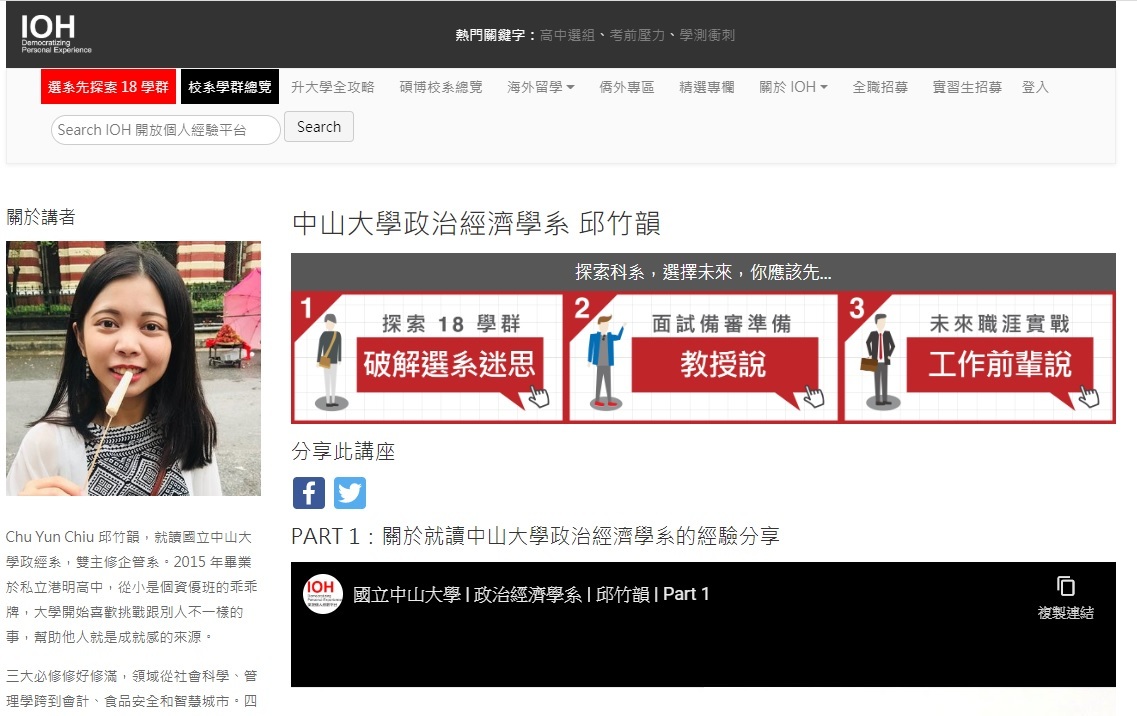
Class of 108: Chiu Chu-yun (original name: 邱竹韻) shares on IOH
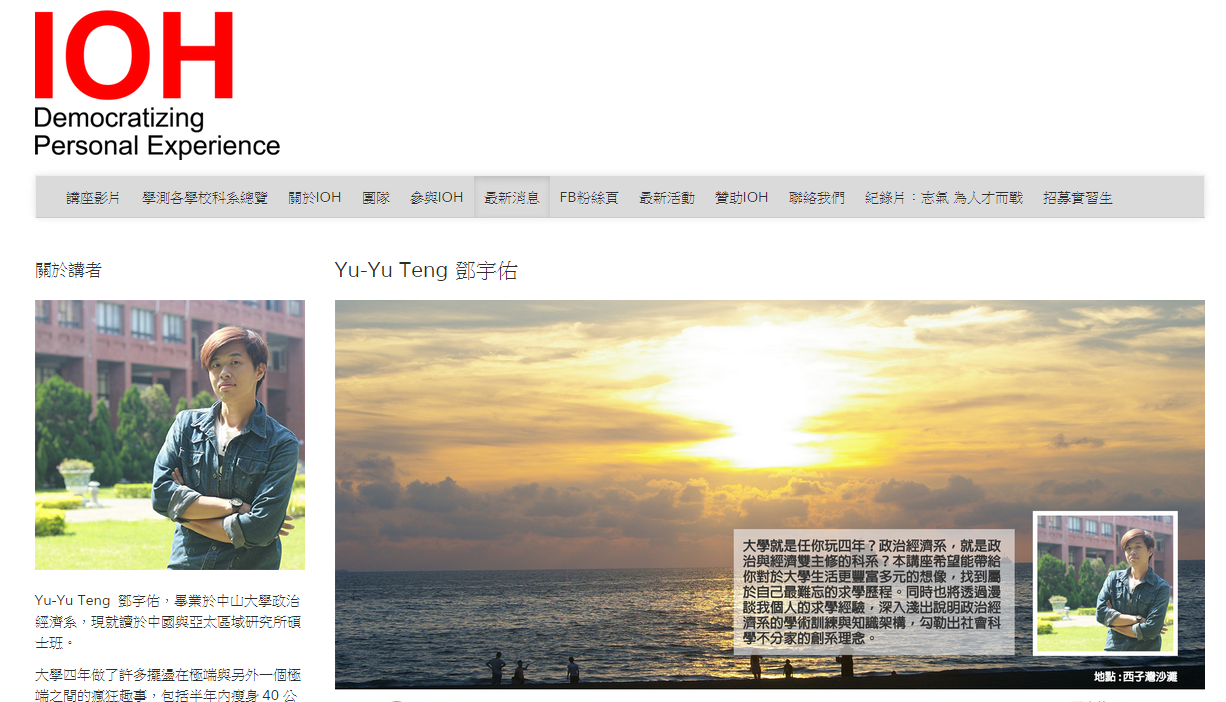
103Class of 103: Deng Yu-you (original name: 鄧宇佑) IOH shares
|
Department of Political Economy, Class of 101 (2012): Chen Jianyu (original name: 陳建瑜), graduate of National Tainan Second Senior High School |
|
‘Competitiveness, creativity, influence …’—all are ‘diverse’ abilities that every parent or young student hopes to possess. To keep up with a rapidly changing outside world and become ‘international top-tier talent,’ we learn several languages. From childhood, we attend cram school and study music, art, abacus mental arithmetic, and more, always afraid of losing, falling behind, or being eliminated. At root, from childhood to adulthood we have been in ‘competition.’ I was never an outstanding student. In college I failed required courses, never ranked among the top ten in my class, and was even rejected when I applied to graduate school. I wondered whether that meant I had been eliminated by competition. Only after studying in the United Kingdom did I find some answers and realize that ‘cooperation’ is as important as ‘competition.’ The Department gave me competition, but also taught me cooperation. Both required and elective courses in the Department commonly involve group presentations. Besides training us in public speaking, they test how we get along with people from different backgrounds and spark new ideas. Disagreements and conflicts are learning: discovering how to share a space comfortably with people whose views differ from one’s own and converse with a smile is a deeper course. It also enabled me to debate naturally in my graduate classes in the United Kingdom and leave class happily, having gained a great deal. Cooperation means discovering each person’s strengths, learning from one another, and growing together. In fact, it is another form of competition. |
|
Department of Political Economy, Class of 96 (2007): Li Juhan (original name: 李居翰), graduate of the Affiliated Senior High School of National Taiwan Normal University; later studied at National Taiwan University’s Graduate Institute of Journalism |
|
A turn at the final moment of my studies In senior high school, I was in what was then called the third track, biomedicine. I eventually discovered that my interest was not there at all, resolutely took additional humanities-track examinations, and somewhat unknowingly entered National Sun Yat-sen University’s Department of Political Economy. I admit that throughout my first year I shut myself away, endlessly wondering how I had ended up in a department I had never heard of, and trying hard to break free. Four years later, when I put on my graduation gown for the tassel-turning ceremony, I was startled by how quickly time had passed. You only discover the advantages of growth in an environment by comparing yourself with others. What careers are there after studying political economy? …… I have probably been asked about career paths more than a hundred times since I enrolled. I have always believed that one’s path is not decided by one’s department; during one’s studies, one can find a faster and more suitable way to move toward one’s goals. While preparing to apply to graduate school through recommendation and selection, I found that political economy students have accumulated more than students in other departments. That accumulation deepens through every course, activity, and public affair in which we participate, giving us more opportunities to enter an ideal graduate school. Looking at Taiwan from the south gives you one more perspective than others have. Here you will find Taiwan’s most beautiful university, a department with balanced development, the strengths of a comprehensive university, and a group of passionate teachers who unhesitatingly run forward with their students—these are why the Department stands out. The effect of an environment in drawing out a person’s potential is no cliché; it is the real four-year experience of a political economy alumnus. |
|
Department of Political Economy, Class of 102 (2013): Yang Siyi (original name: 楊絲貽), graduate of Tulpehocken Area High School in the United States (also attended Hsinchu Girls’ Senior High School), then a first-year student at National Taiwan University’s Graduate Institute of Journalism |
|
Political economy training lets us thrive in every field. Thinking beyond established frames and analyzing events from rational, objective, and comprehensive perspectives are shared traits of our students. In addition to the ability to argue clearly, political economy students can use mathematical models to explain economic phenomena; this complete logical training is unmatched by other departments. The Department’s suitably flexible curriculum lets students build solid foundations in political science and economics in their first and second years and establish a strong academic background. In the third and fourth years it offers discussion courses based on interdisciplinary reflection, such as English-language seminars on current political-economic affairs, history of economic thought, and managerial economics, allowing students to challenge and surpass themselves. Its open and free atmosphere also lets students develop their interests without boundaries. Personally, besides serving as a student association officer, I led the university’s student ambassador group and worked as a study-tour leader during winter and summer breaks. My most distinctive experience was as an information intern at the American Institute in Taiwan, Kaohsiung Branch Office. Familiarity with political-economic issues and facility with social media earned me high evaluations during the internship. What I miss most are the Department’s fine teachers and friends. No matter when or where, whether students have graduated or not, its teachers offer the soundest advice and most sincere encouragement; they even form teams with students for departmental sports competitions. I think the Department ranks among Taiwan’s very best university departments for this kind of lifetime-guaranteed aftercare. |
|
Department of Political Economy, Class of 101 (2012): Ye Qinhua (original name: 葉欽華) |
|
How far have you come on the road to your goal? Like most examinees, I did not get in through the General Scholastic Ability Test. For the entrance examination I ranked departments in order, and, choosing a school rather than a department, filled in all the business-related choices. When the results were announced, I was assigned to a department I had never heard of before—the Department of Political Economy. Like most senior high school students, I heard my parents say that once I got into university I could live freely. I had one thought: after being taught from childhood that study came first, I would become like a sponge thrown into the sea at university—constantly absorbing, continually resetting. This happened to coincide with the idea the Department gives us: you can be different. When you enter the Department, you are different, and no one finds that strange; professors instead encourage you to be different from everyone else. In class, some ideas in political science and economics connect while others conflict, prompting us to open our senses, listen, and accept more diverse voices. Gradually, we find that the same matter is often only a difference of viewpoint, without a right or wrong. There are many gray areas in life; things need not be strictly black or white. Beyond the classroom, the Department encourages students to participate in the student association and try many different opportunities. These experiences develop independent thinking, teamwork, and organizational skills—the very abilities that carry over into the workplace. If you hold great ideals, join the Department of Political Economy! The Department can help you consider where the road toward your goal should lead. Sometimes you can reach places others cannot precisely because you have taken a road different from theirs! |
|
Department of Political Economy, Class of 97 (2008): Wang Xinkai (original name: 王新凱), graduate of Chenggong Senior High School |
|
During the summer vacation of my second year of senior high school, I went to a university fair between cram-school sessions. I wanted to learn which departments suited me and see more of the differences among them. At the time I could not distinguish finance management, business administration, and finance departments. I only knew my longing for university, enthusiasm for the future, expectation of entering the next stage, and desire to learn. Although my grades had always been only in the middle to lower range and I had never thought specifically about how my future would unfold, meeting Professor Mon-Chi Lio (劉孟奇) at the fair opened a new window of knowledge. Political economy not only combines the two most important subjects in the social sciences; it also provides tools for analyzing problems. Its training is not merely to make you a politician, economist, or political economist, but to make you an independent-thinking, critical, and mature individual. Coursework is intensive and crosses fields, becoming progressively more advanced with each year. During study, you can also continue taking electives in disciplines that interest you. The Department’s professors are experts in many fields; they provide guidance in learning, direction in life, and the most earnest advice. When I chose to apply to the Department, my parents worried that I would not find a future career. Four years later, with the support of faculty and teachers, I had served as student association president and vice-captain of the university basketball team, won second place in a national planning competition, interned in a legislator’s office, and participated in election work. These valuable experiences brought me to where I am now and led my parents to believe that whatever work I do, I can do it well. If you choose a department that makes employment convenient, you have only gained a fishing rod, useful for nothing but catching fish to eat. But if you choose the Department of Political Economy, you will board a ship called ‘wisdom’ and roam the vast ocean of knowledge; what you gain will far exceed what you expect. (The source text contains a repeated corrupt trailing phrase.) |
|
Department of Political Economy, Class of 97 (2008): Qiu Boren (original name: 丘博仁), graduate of Taichung First Senior High School |
|
I am Qiu Boren (original name: 丘博仁), a Class of 97 (2008) political economy student. After graduating, I first entered the workforce, then enrolled in National Sun Yat-sen University’s graduate program in business administration; I am now a first-year doctoral student. I would like to share how study in the Department helped me enter the workplace, return to school, and find direction in life. As its name suggests, political economy includes the foundational social-science subjects of political science and economics. Economics courses strengthened my logical thinking and reasoning, while political-science courses taught me to accommodate diverse ideas and develop the ability to examine complex, abstract issues and to communicate and express myself. My first job was as a researcher conducting market research at the consulting company 全國意向 (original brand name; official English name unverified). I found that I could see more of the hidden information behind survey data and understand market characteristics. In research, I can consider at once the economic and political effects on enterprises; when examining management problems, I can understand their nature more deeply and propose better responses. A common question about studying political economy is what job one will do after graduation. It is difficult to answer because there are so many possibilities! There is no framework here that requires a particular occupation. There may be anxiety, but life has no ready-made road. In the Department, I learned to think independently, actively encounter the possibilities of the future, consider the direction I want to take, and hold myself responsible. Department teachers never stint on guidance, support, or encouragement. Even after graduating, I returned many times to ask their advice, always gaining greatly. From them I received not only knowledge, but also many principles for conducting myself and dealing with others. This is my reflection, and I hope it helps more people understand the value of the Department of Political Economy. |
|
Department of Political Economy, Class of 101 (2012): Zhang Yuhui (original name: 張鈺惠) |
|
The author is currently a master’s student in political science conducting short-term research in Indonesia. In repeated contacts with Taiwanese businesspeople there, I often hear that Taiwanese university students study matters too narrowly in higher education and cannot integrate across fields. Some businesspeople have even told me that Taiwan’s political-science and economics departments should be merged, so that events can be understood comprehensively. At such times, I proudly tell them that I graduated from National Sun Yat-sen University’s Department of Political Economy, one of only two departments in Taiwan (the other is Tamkang University’s Department of Global Politics and Economics) that integrate politics and economics. The problems they describe basically do not exist among our graduates. Our solid training also remedies the lack of interdisciplinary integration they mention. Although I shifted to political science in graduate school and specialize in international relations, I still cannot separate myself from economics. When reading literature or the news, I often quietly rejoice that I studied political economy as an undergraduate. Without its solid grounding in basic economics, I might not be able, as I can now, to approach problems from diverse angles and identify their core. Required political economy courses are concentrated in the first and second years. Afterwards, students have substantial flexibility to explore other knowledge that interests them: financial management and accounting in the College of Management, foreign-language courses in the Department of Foreign Languages and Literature, or performance- and costume-related courses in the Department of Theatre Arts, for example. They may also take graduate courses early in campus institutes and complete bachelor’s and master’s degrees in five years. A high degree of autonomy and abundant resources let political economy students choose freely inside and outside class, converse and learn across different fields. |
|
Department of Political Economy, Class of 102 (2013): Li Jinjia (original name: 李晉嘉), graduate of Kaohsiung Municipal Hsin Hsing Senior High School |
|
National Sun Yat-sen University’s Department of Political Economy combines learning in politics and economics. Its training is comprehensive and solid: political courses develop students’ critical thinking, and numerous group presentations develop teamwork and oral-expression skills. Economics courses train students to analyze current affairs through theory and professional knowledge and understand how today’s economies operate. Combining the two fields gives students the capacity both to solve problems and to analyze them. Interdisciplinary learning gives political economy students many choices in planning their future. Rigorous thinking and professional theoretical foundations allow the Department’s graduates to perform outstandingly in graduate school and workplaces in every field. |
|
Department of Political Economy, Class of 102 (2013): Sun Xiang (original name: 孫祥), graduate of Hsinchu Senior High School |
|
‘What can political economy graduates do in the future?’ Many people ask this. Frankly, it has no single answer, because the Department is not a place for cultivating narrow specialists and single skills. The Department’s principal teaching approach guides students toward careful observation and logical thinking, leading to critical reflection. Political courses use teamwork and project reports to reflect on social affairs; economics courses use economic thought to explore solutions to social issues. In the curriculum, the first year teaches foundational principles such as political science, sociology, and principles of economics. The second year develops a deeper understanding of political and economic dimensions through international relations, microeconomics, macroeconomics, and more. The third year integrates across fields through political economy and international political economy. Finally, the fourth year includes research projects that let students bring together and apply what they have learned over four years. The Department’s teaching arrangement proceeds from simple to difficult, making it easy for students to begin. This two-field approach lets people interested in both fields explore broadly, and also helps people who are still uncertain of their aspirations find an interest. |
|
Department of Political Economy, Class of 102 (2013): Lin Zhiwei (original name: 林智偉), graduate of Taichung Second Senior High School |
|
NSYSU Political Economy: Astonishing NSYSU In the Department of Political Economy, you learn courses that give equal weight to politics and economics. You can learn independent thinking and oral expression, and understand economic changes and political contexts. But after coming to National Sun Yat-sen University and the Department, you will find that what you learn is far more than endless knowledge in a vast sea of books. At National Sun Yat-sen University, you can join many clubs and camps to broaden your horizons and enrich your experience. In the Department, you can learn how politics and economics influence one another. By participating in the student association and the Political Economy Festival, you can learn how to organize a successful event and interact with others; you can join us in entering and caring about society. With your continued growth and the Department’s excellent environment, NSYSU Political Economy will surely astonish not only NSYSU, but perhaps the whole world in your hands. |
|
Department of Political Economy, Class of 101 (2012): Wu Wanxi (original name: 巫婉曦), graduate of Hsinchu Girls’ Senior High School |
|
Political economy training is thorough and diverse. The first year offers foundational training in political science, economics, sociology, and more; the second year deepens those roots; from the third year it emphasizes integration of different fields; and fourth-year projects are a comprehensive application of four years of learning. Besides lectures, classes include many group oral reports and individual written reports. Group reports cultivate teamwork and oral-expression skills; individual reports train careful thought and logical coherence, teaching students to use different perspectives and modes of thought, collect and analyze materials, and explore their core concepts and developmental contexts. Interdisciplinary learning enables Department students to choose future directions according to their interests. Whether pursuing further education or entering the workforce, the perspectives and integrated abilities cultivated by political economy training are highly competitive. |
|
Department of Political Economy, Class of 100 (2011): Gong Chuqiao (original name: 龔楚喬), graduate of Kaohsiung Senior High School (eighth student association president) |
|
At the individual-application stage, I chose to join the Department of Political Economy. Before that I had done considerable research and gradually gained an initial understanding of the training and knowledge it could offer. Along with my excitement, I came to this big family with a curious heart. The Department offers interdisciplinary courses in the two broad areas of politics and economics. In political courses, I learned many different ways of thinking and principles for dealing with people, while numerous presentations helped me express my inner ideas better. In economics courses, I learned modes of thought different from those I had known; interesting economic models paired with real-life examples helped me see the fundamentals of problems and made my thinking clearer and more logical. For me, just out of senior high school, the form of university life was a wholly new challenge—perhaps more an important stage of confronting a collision of values. Newly arrived, I was like a grain of sand thrown into a vast ocean, suddenly facing directions on every side but falling into bewildered panic. Study, clubs, friends, love, family, and the like have no standard answers, yet are the questions most worth considering. The Department of Political Economy is a warm big family: beyond professional knowledge, it is a cradle that provides a sense of belonging. Department of Political Economy, welcome to join us. |
|
Department of Political Economy, Class of 96 (2007): Gao Weijun (original name: 高維駿), graduate of the Affiliated Senior High School of National Taiwan Normal University |
|
In the Department, teachers want students to work hard at cultivating independent thought. They will not tell you what suits you; you must think for yourself and plan for yourself. The Department gives students the greatest freedom to choose their own suitable direction—whether politics or economics, it will always be a home you can rely on. |
|
Department of Political Economy, Class of 97 (2008): Jiang Binglong (original name: 江秉隆), graduate of Yanping Senior High School |
|
At National Sun Yat-sen University’s Department of Political Economy, teaching from a global perspective gives us broad vision. Its free and open atmosphere encourages us to try boldly. Its spirit of practical service leads us into society to understand society. Under the Department’s ideas of breadth, freedom, and service, and with professors using action to lead us in understanding the operation of governments, businesses, and nonprofit organizations in society, choosing NSYSU Political Economy will surely make your university life full of challenges, surprises, and delight. |
|
Department of Political Economy, Class of 96 (2007): Li Xiaofan (original name: 李筱帆), graduate of Changhua Girls’ Senior High School |
|
Perhaps you entered the Department with dreams; perhaps you entered because of predicted admission placement. Whatever the reason, after joining the political economy family, its solid training that combines theory and practice will make you an outstanding person with an international, broad perspective and management and leadership ability. |